Posted on

Blocking — How to “Encourage” Your Blocks to Size

Although the importance of accurate seam allowances is drilled into every quilter, most of us end up with blocks that are not quite the right size at times. Knitters are masters at blocking their pieces into shape, and quilters can add this skill to their arsenal, too. We’ll show you how to do this using sample blocks from Jinny’s Starstruck BOM quilt.

You will need:

  • your not-quite-perfect block
  • a pressing surface into which you can pin firmly
  • a permanent or erasable marking pen
  • ruler (a large square is great)
  • T-pins (they are large, sturdy and can hold up to heavy steam)
  • a steam iron

Most of us have a portable pressing surface with gridlines. We like to cover ours with muslin or another light-colored cotton fabric for two reasons: the gridlines probably don’t match our desired block size, and (if you are like the Studio staff) the pressing surface is likely to be a little grungy!

Stretch the fabric over the pressing surface and pin it in place. Mark the desired block size on the cloth. Here we’ve used a heat-erasable pen which makes it easy to re-use the cloth for different-sized blocks.  If you will be blocking a large number of same-size blocks, you might want to choose a marker that won’t disappear with heat. In this instance, the block needs to be 12-1/16″.

Start by using T-pins to pin each corner of the block and the center of each side, stretching the corners and edges to meet your marked block outline.

Continue pinning. Once everything is pinned, press the block from the center out to the edges, using steam, steam, steam! Let it cool completely before removing the pins.

Once everything is pinned, press the block from the center out to the edges, using steam, steam, steam! Let it cool completely before removing the pins.

You might also try spraying your block with a sizing agent after pinning but before steaming. That can help your block hold its shape.

There is a limit to how much you can stretch a block, but this technique can give you blocks that are much closer to the desired size — which will make assembling your quilt much easier. Blocking with steam can also be used to shrink up a block a little bit.

As always, we recommend you test this process on an extra block before trying it on one destined to be used in your next quilting masterpiece!
Posted on 7 Comments

A Solution for “Just-Too-Narrow” Quilt Backing Fabric

Most quilters are frugal when it comes to backing their quilts. Of course, it’s important to use the same quality fabric as you used on the front. But it’s frustrating when your quilt is just a little wider than your backing fabric. That’s where creativity comes in.

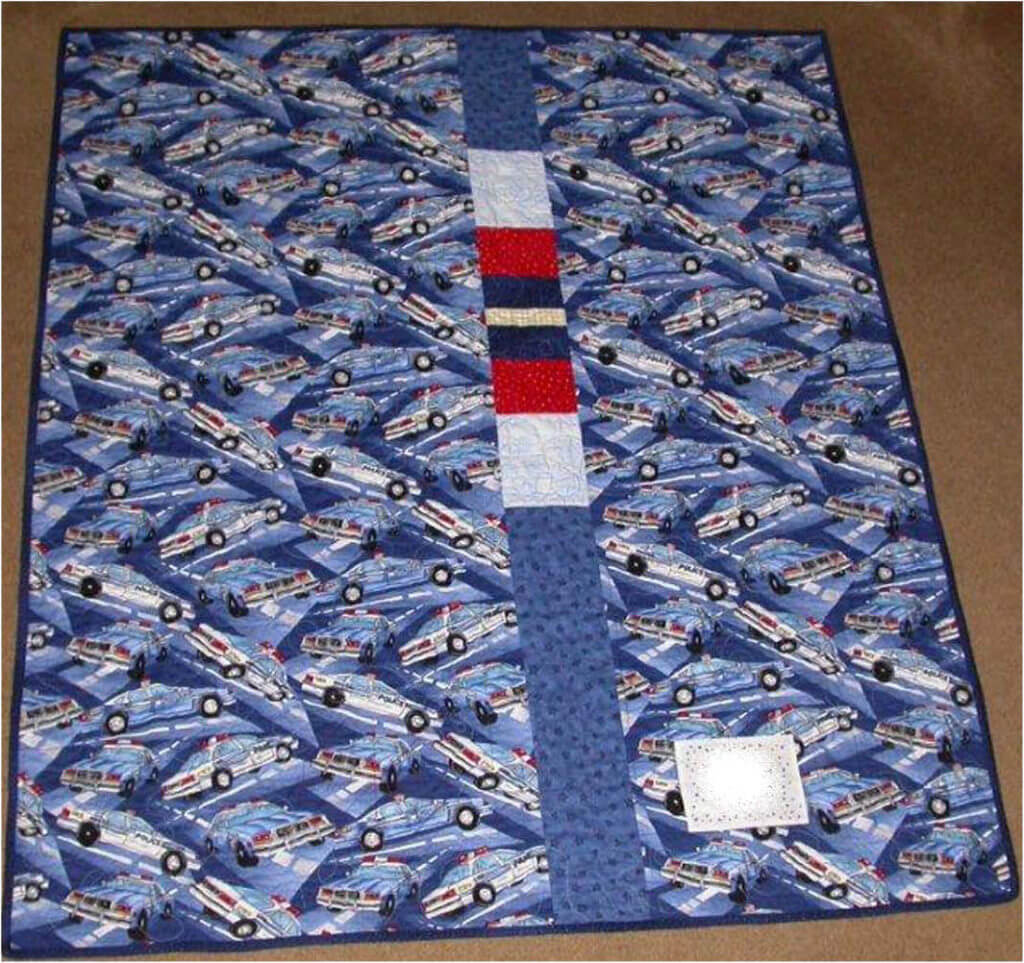
You can always make your backing wider by adding a panel of contrasting or co-ordinating fabric or orphaned blocks.

This quilter added a panel of pieced fabrics left over from the front of the quilt.

Orphan blocks were the salvation here . . . and now the quilt is virtually two-sided. The quilter used nine left over blocks, then framed them in a coordinating fabric.

Another solution is to piece your backing with a diagonal seam.

Several years ago, quilter John Flynn introduced us to a method using a diagonal seam across the back to save on fabric. It works on quilts that need backing up to about 60″ wide.

This Diagonal Backing Worksheet illustrates how to make a diagonal backing and tells you how much fabric you need for you quilt. It works two ways.

  • First, it is a PDF form so you can download it and then fill in the first three boxes on your computer. Adobe Reader will automatically do the calculations and figure out how much fabric you need for backing.
  • Second, you can download and print the form. Just follow the instructions to determine the fabric requirements.


Posted on

Binding Quilted Projects

There are various ways to finish off the edge of a quilt. Jinny’s favorite method is to add a narrow binding in either the same fabric as that which is at the outer edge of the quilt, or with a fabric that coordinates with the fabric around the edge.

Double-fold binding can be made from either straight-grain or bias strips. Jinny’s preference is bias binding because she feels it provides a smoother finished edge. It is also more durable because straight-grain binding is folded along one continuous thread, creating a weakness that can cause it to wear and fray much more quickly.

To make double-fold binding, cut strips of fabric four times the finished width of the binding, plus the seam allowance. Jinny usually works with 2-inch-wide strips.

Turning Binding to the Front of a Quilt

When Jinny has used a border print on the outside of a quilt, she likes to sew the binding to the back of the quilt and turn the binding to the front, the opposite of what most quilters do. This lets her fine-tune exactly where the binding is stitched down on the front so that she doesn’t cover up any design elements from the border print.

For detailed instructions on how Jinny adds binding to a quilt, download her binding reference sheet, Binding a Quilt the Jinny Beyer Way.

Binding Odd Angles

If you are binding a quilted item with odd angles (such as a table runner with pointed ends), Marci Baker has a terrific video showing you how to deal with these less-common angles.  You can find the video at the link below
Binding Odd Angles

Joining Binding Ends

Getting a smooth, invisible join of the two ends of the binding can be a challenge. Here are two simple techniques that the Studio staff and our customers love.

This is the technique that Studio staffer, Elaine, swears by. Cut the beginning of your strip at a 45°­ angle, sew the binding down and then use the cut end as your guide for cutting the tail.

McCall’s Quilting magazine has a video showing the technique.
Watch the McCall’s Quilting video

Posted on 1 Comment

Hand Quilting with a Spoon

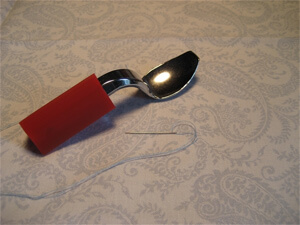
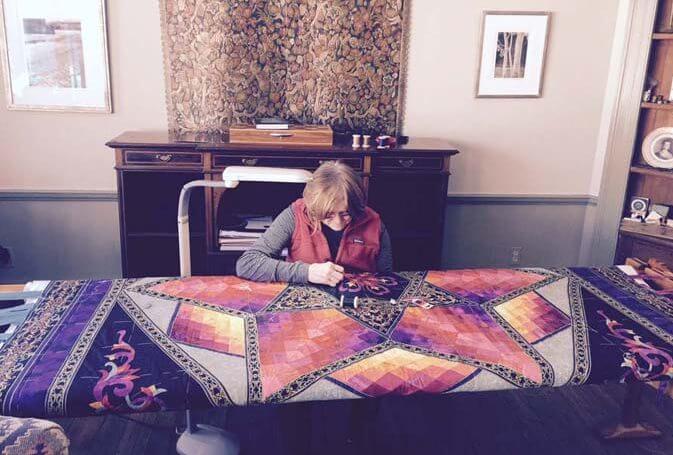
I used to use my fingers underneath the quilt frame, gently poking them with the needle and then pushing up into the underside of the quilt to bring the needle back up again. For more than 10 years, however, I have been using a spoon on the underneath side. It saves fingers and for me produces smaller and more uniform stitches. (Actually my use of the “spoon” is thanks to Gayle Ropp, a quilter in the northern Virginia area who showed me how it was done.)

A brief video below shows you the basic process. But the idea is that you have a narrow rigid item poking into the quilt from underneath the frame. With a spoon, the thumb on the hand that is under the frame fits into the bowl of the spoon and the edge of the spoon pokes into the underside of the quilt. When the needle goes down from the top of the quilt, it hits the rounded edge of the spoon and then “glances off” the edge and comes back up again. There is sort of a rocking motion that eventually allows uniform stitches.

When I first tried this method, I quilted half of the quilt before I finally got the hang of it. Michael James has used a thimble that he flattened with a hammer to produce a sharp edge on the side of the thimble. He used this on the underside of the quilt. Aunt Becky has a product that is a metal piece that you fit over your finger and does a similar thing. I once happened upon a group of women in rural South Carolina who were quilting a raffle quilt. One older lady was quilting away so fast that I was truly impressed. I asked how she kept her fingers from getting sore and she proudly whipped out her hand from underneath the frame and exposed her thumb which had a quarter neatly taped to it. She used that quarter in a similar fashion to the spoon.

A quarter, spoon, Aunt Becky’s gadget, a pounded thimble, whatever, any sharp item poking into the underside of the quilt which the needle can glance off of may help you to produce more uniform stitches. Quilting is such an individual thing and each person has to use the method that works best.

I now use the TJ Quick Quilter spoon made specifically for quilting. It is chrome plated and doesn’t scratch so it lasts quite a long time. It has become quite popular so we now carry it in our shop and our online store.

Posted on 1 Comment

Hand Quilting

There are so many factors that can influence your success in hand quilting. This tip will focus on a few.

First and foremost, the tools and materials you use really make a difference.

Fabric
Use high-quality, apparel weight, 100% cotton fabric. If the fabric is heavy, you will get larger stitches.

Batting
I like to use 100% cotton batting. One of my favorites is Quilters’ Dream Cotton. This batting comes in several weights. I like the lightest weight, Request. The thicker the batting, the larger the stitches and the thinner the batting, the easier it is to quilt and get small stitches.

Thread
I like a pre-waxed thread made specifically for quilting. There are many brands and they now come in a wide range of colors. The one I use most is YLI quilting thread. It is a little more wiry than standard thread and produces a nice quilting stitch.

Needles
I use a between, size 11, for all my hand piecing and quilting. It is a sturdy needle and because it is so short it does not bend as readily. There are a number of needle companies and I have experimented with many of them. Frankly, in my experience, the ones made in China are not the same high quality as those made in England and Japan. I would advise you to check the packaging. If it says “packed in England” and not “made in England,” the needles are probably made in China.

My favorite needle of choice at the moment is the Colonial Needle Company’s Super Glide, Between, Size 11. This needle is made in England and has a special coating that allows it to glide more smoothly through the fabric.

Spoon
I can’t quilt without a spoon. You may wonder what that is.  When quilting, you need a hand underneath the quilt frame to receive the tip of the needle and push it back up again. After a while your finger gets really sore. There are various devices to use under the frame that will guide the needle back up. Some thimbles have sharp ridges around the top for just this purpose. Aunt Becky’s Finger Saver is another device.

A (quilting) spoon and pliers — two hand-quilting essentials for Jinny.

Once, I encountered a group of older women around a quilting frame. One of them was quilting up a storm and I asked what she used underneath. She proudly held up her thumb where she had a quarter taped. She was using that to guide the needle back up.

I have tried many different things, but my favorite is TJ’s Quick Quilter Spoon. It saves many sore fingers.

Pliers
When quilting, sometimes if you have stacked four or five stitches on the needle it is difficult to grab the needle and pull it out. I use a small pair of pliers for this purpose. I just keep them on my quilting frame and grab them when needed.

Thimbles
I never sew without a thimble. I have written two blogs about thimbles and recommend you read, Put A Thimble on It and Thimbles, Part II – My Favorite Thimbles.  These blogs cover how to choose a thimble and what my choice is.

Quilting Frame
I have saved the most important for last. To get good even stitches you must use some type of frame or hoop.  It is the same as doing embroidery. Without a hoop, the work is either too loose or too tight. I can’t stress enough the importance of this.

My book, Quiltmaking by Hand, has a whole chapter on quilting, designs for quilting, how to put a quilt in a frame or hoop, and so much more. If you have an interest in hand quilting, this book would be useful for you.

And Finally, Practice!
If you have the right fabric, batting, tools and some sort of frame, the best way to practice your quilting is to put a quilt in a hoop or frame and start quilting. The first stitches will probably not be to your satisfaction, but you will find that you will improve as you keep stitching.

I was very disappointed when I started quilting my first quilt. Here is a close up of how those first stitches looked and another several months later when I was achieving smaller and more even stitches.

My first stitches were only four per side.

After four months, my stitches were better — seven per side.

By my third quilt, I was very comfortable hand quilting.

Like everything else, it takes time to develop your quilting skills, but I promise that good tools will make all the difference!

Posted on 2 Comments

Perfect Points & Seams with Jinny’s Perfect Piecer

The Perfect Piecer is a simple tool designed to help quilters achieve perfect points and even stitching lines.

The tiara-shaped acrylic template includes all the common angles used in traditional quiltmaking. Simply line up the correct angle on the Perfect Piecer with the shape you are stitching. Mark pencil dots through the holes and you will know exactly where to begin and end your stitching.

The ¼” sewing line makes it easy to add seam allowance to templates or fabric patches.

Watch Jinny demonstrate the Perfect Piecer, below. Then, download this free, three-page Guide to Using Perfect Piecer.

Posted on 2 Comments

Joining 6 Points

When sewing six points together, sew the first three pieces and then the second three, and finally one straight seam will join the two halves together.

Step 1

Begin by laying out the three pieces for the first half. Pick up piece A and, with right sides together, pin it on top of piece B.

Step 2

Starting at the outside edge and sewing towards the center, sew just to the point where the seam allowance would cross, and take a small back-stitch. Do not break the thread.

Step 3

Take the pin out, open up the seam and gently finger-press the seam towards the right.

Step 4

Now take piece C and place it, right sides together, on top of piece B. You should be able to feel the ridge from the seam allowance with your thumbnail. Carefully bring the needle directly through the end of the last stitch it made, and through the base of the seam allowance. Take a back-stitch along the”ridge, and then continue sewing this last piece.

Step 5

Sew the other three pieces in the same manner so that you now have two halves.

Check to make sure that the point in the middle of each half is securely bounded by the points on either side. If the point is not neat and sharp at this stage, it will not be neat and sharp when the two halves are sewn together.

Step 6

Place the two halves together with right sides facing each other, making sure that the points of the center piece in each half meet exactly. Place a pin through the point.

Step 7

Sew from the edge towards the center. As you reach the center, carefully pull out the pin, bring all the seam allowances towards the left.

Sew up to the seam line, making sure not to catch any of the seams in the stitches. Take a back-stitch at the center and then pass the needle through the base of the seam. Now pull all the seams towards the right, take another back-stitch right next to the seam, and then continue sewing across.

Posted on

Joining Four Points

When sewing anything where four points join together, such as four squares, first sew them together in pairs of two.

Press the seams of each section so that, when right sides are placed facing each other, the seams will go in the opposite direction and will nest together.

Place the two sets of squares next to each other with right sides facing and one seam going one direction and the other in the opposite direction. This creates a ridge where the two seams can butt next to each other ,helping to keep them in place. Put a pin directly through this ridge and begin sewing from one side.

As you approach the center, carefully pull the pin out and make sure that the two seams are still butted next to each other. Now (if you are right handed), gently pull all the seam allowances to the left and sew right up to the seam line. Make a tight back-stitch.

Next, gently pull the seam allowance to the right, take another back-stitch right next to the seam and continue sewing across the seam.

The secret of getting points to match when hand piecing is to take these tight back-stitches where seams meet, and to never sew the seam allowances down, always leaving them free.

Posted on

Joining Eight Points

Step 1

When joining eight points, sew the first four pieces together and then the second four, and finally one straight seam will join the two halves. Begin by laying the four pieces for the first half out onto a table or your lap.

Step 2

Pick up piece A and, with right sides together, pin it on top of piece B. Starting at the outside edge and sewing towards the center, sew just to the point of where the seam allowances on the piece would cross, and take a small back-stitch. Do not break the thread.

Step 3

Take the pin out, open up the two pieces and gently finger-press the seam towards the right.

Now take piece C and place it, right sides together, on top of  piece B. You should be able to feel the ridge from the seam allowance with your thumbnail. Carefully bring the needle directly through the end of the last stitch and through the base of the seam allowance. Take a back-stitch along the ridge and then continue sewing to the end.

Step 4

Check to make sure that the point on piece B is securely bounded by pieces A and C as shown. If this point is not neat and sharp at this stage, you will not have sharp points when all eight are joined.

Step 5

With the right side facing, finger-press the seams towards the right. Pin piece D on top of piece C.

Using a new thread, bring the needle all the way from piece A, at the exact point where the first seam ended, and through the bases of the three points and onto piece D.

Step 6

Back-stitch along the edge of the seams and continue sewing the last piece.

Sew the remaining four pieces in the same manner so that you now have two halves. Check to make sure that the points in the middle of each half are securely bounded by the points on either side.

Step 7

Place the two halves together with right sides facing each other, making sure that the points of the center piece in each half meet exactly. Place a pin through the point, with the point of the pin coming just below the bulk of all the seams of the points.

Step 8

Sew from the edge towards the center. As you reach the center, carefully pull out the pin, bring all the seam allowances towards the left and sew up to the seam line, making sure not to catch any of the seams in the stitches.

Back-stitch at the center and then pass the needle through the base of the seams. Now pull all the seams towards the right, take another back-stitch right next to the seam and then continue sewing across to complete the seam.

Posted on

Hand Piecing & Even Stitches

Jinny is often asked how to achieve even stitches when hand piecing. She replies:

It is all a matter of maintaining proper tension. You may be familiar with the “sewing birds” they had years ago. The birds were attached to a table and were used to anchor the fabric while one hand held the other part of the fabric at a good tension. The free hand took the stitches.

Tension on the fabric is of the utmost importance. Without proper tension, your stitches will be too loose or too tight. It is the same thing as quilting. Without a hoop or frame your stitches may be too loose or too tight. When I am hand piecing, I hold the fabric in both hands and I pull the hands slightly away from each other, creating tension on the fabric. The hand with the needle “gathers” the fabric onto the needle. I constantly maintain the tension as I sew the stitches.

For complete information on hand piecing and much more, see Jinny’s book, Quiltmaking by Hand.