Posted on 16 Comments

Tessellations

People have been fascinated with interlocking designs throughout the ages.  I became interested in this type of design in the 1990’s and diligently studied the work of Dutch artist M.C. Escher to try and figure out how he created his amazing tessellations. One day the light bulb went off and it all fell into place. It is so simple!


The first question is “What is a tessellation?” A tessellation is any shape that can be repeated over and over to fill a surface without gaps or overlaps.

Squares, triangles, hexagons, and diamonds are all tessellations because they can fill a surface without gaps.


Those are easy to see, but the more intriguing tessellations contain more complex, interlocking shapes. There are a few rules to follow and these rules must be adhered to or the shape will not “tessellate”.

So the number one rule is that you must begin with a base shape that tessellates. Number two is that you must give it back to the side of the shape that is equal in length. It makes a difference which side you give it back to or whether you flip or rotate the shape. Here are a few designs with this simple square and several of the patterns that can be created by merely putting the cut piece back in different ways.

Lets look at the simplest of the tessellations, the square. It is easy to see how it can repeat over and over to fill a surface without gaps. But what happens if I take a chunk out of that square? It is no longer a tessellation.

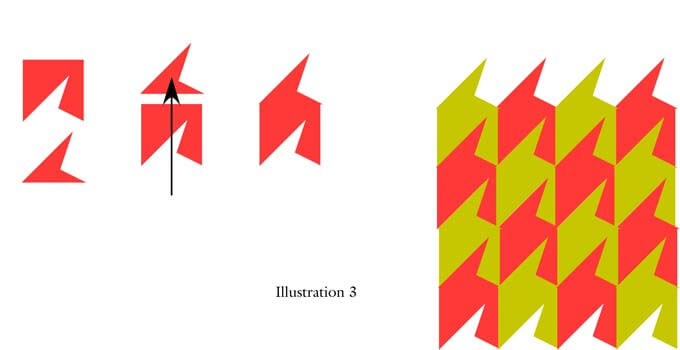


So here is the “aha” moment.  The secret to creating tessellations is this: if you take away a piece of a shape, give the piece back to another side of the shape. You will once again have tessellation because the piece you give back will fit into the hole of an adjacent piece where it was taken away.


There are a variety of ways to give a shape back and a few rules that must be followed. You can rotate the piece or not depending upon the shape used. I wrote an entire book on this called Designing Tessellations. Unfortunately it is out of print, but it is still available as an “e-book.”


I am currently working on an online class that will be offered through my website sometime in the future. It will cover all the rules, shapes that can be used, how to turn the shape into a usable pattern for quilting and much more!

I’ll keep you posted as to when it will be available but for now, why not come to the Studio and take a class in person. I will be teaching Designing Tessellations August 11 & 12.

Posted on 6 Comments

And the winner is……

Back in the beginning of May we announced a contest inspired by a box of packets of 10-inch squares from last year’s Quilters’ Quest. We challenged you to design and make a quilt (or quilt top) using these fabrics. Photos had to be submitted by June 18th.


10 inch squares


What fun we had looking at your entries! Each member of the Studio staff, totally untrained in any kind of quilt judging, voted on his or her favorite.  The quilter who got the most votes wins a $100 Studio gift certificate.

About a dozen people managed to finish their projects and submit them in the short amount of time given. There was a wide range styles and entries came from around the world.

And the winner is…Sarah Kirtland from Williamsburg, Virginia.


Sarah's design


Sarah’s quilt, Here Comes the Sun, is based on the classic kaleidoscope block. She knew she wanted to do something with triangles after seeing my new Thousand Pyramids quilt. She spent four days simply drawing, working on the design. Sarah was at the Studio at the beginning of the month taking a class and picked up a few fabrics to supplement the 10-inch squares. Then the fiendish sewing began and didn’t stop until shortly before the deadline. She didn’t believe she had a chance to win but thought it would be a good exercise. I’m reminded of a saying by Mark Twain: “…you will be more disappointed by the things that you didn’t do than by the ones you did do.’

There were many other fabulous quilts. Here are just a few.


David S Design


David Schulz took inspiration from local Native Americans who had different names for different parts of the Potomac, calling the river above Great Falls, where the Studio is located, “Cohongarooton”, meaning “honking geese.” He included flying geese blocks along with a variation on a block design from my Quilter’s Album of Patchwork Patterns (Island Compass 380-11).  He also used the Golden Ratio throughout the piece. Even the number of flying geese is included in the Fibonacci sequence. The finished piece measures 29” x 18”.


Charlie's Design


This Phoenix quilt came from Charlie MacDonald and we enjoyed his description of the process, the trials and tribulations. He loved the palette from the Quilters Quest. It reminded him of sunset/sunrise “and somehow the colors got him thinking of a Phoenix rising in flame from the ashes.” He used his Apliquick tools for the appliqué. Charlie said he learned a lot from making this and already has ideas for Phoenix 2.0.


Tom's Design


Tom Dengler took an interesting approach. He writes: “I was inspired to find a way to challenge myself to use both sides of the fabric based on some ideas I had first seen used in watercolor quilts. The white gives the illusion of piercing the fabric by piecing the fabric backside. I learned that hand stitching the corner first gives a much neater appearance.” It is called Dos Rayos de Luz.

One thing that I particularly loved seeing was how many truly challenged themselves to try something new and, it seems, are very glad they did so. Here are more of the wonderful projects we received pictures of. We have no stories to go with them but I want to thank each and every one of you for participating and congratulations to all for your beautiful work.


Designed by Diane McGuire
Designed by Diana McGuire


Design by Barbara Bell Hanger


Design by Michaela Burgnon


Design by Bernerdett King


Design by Margo Karczewski


Design by Jeanette Bayliss


Design by Susan Meinholtz


Design by Dana Brewer
Posted on 2 Comments

Patriotic Quilts

The new McCall’s magazine, The Best of McCall’s Quilting – 22 of Our Most Popular Patterns, features a quilt I designed for them several years ago, Lone Star Salute.

lone star
Lone Star Salute

Upon seeing it again and with the election in the forefront and the Fourth of July approaching, I began thinking about commemorative quilts. We have certainly seen many patriotic-themed quilts over the years and, I must admit, I have done my share to add to the pool of these types of quilts. Some of them are personal quilts and others are ones that I designed for patterns.

Dolly Madison Star
Dolly Madison Star

In 1976 when I had been quilting for only four years, a friend asked me if I was going to make a quilt commemorating the bicentennial. I hadn’t thought about it but decided that was a good idea. While I think the overall design and balance leaves a lot to be desired, I learned a tremendous amount during the process of making it. First of all, I wanted the blocks in the quilt to have been named for some event in our country’s history. I have blocks such as Dolly Madison’s Star, 54-40 or Fight, Mrs. Cleveland’s Choice. I even Patchwork Patternscreated my own block of the bicentennial logo.

All of those blocks were to be a 10-inch finished size.  Since I knew it would be impossible to find all the patterns in a 10-inch size, I had to figure out how to draft all of those designs. Intrigued by the drafting process, I began teaching pattern drafting to my students and that lead to my first book, Patchwork Patterns, published in 1979.

Drafting the 50 five-pointed stars to fit into a larger five-pointed star was a challenge but I eventually figured out how to do it. Another challenge was fitting exactly 200 triangles into the border that surrounds the central motif.

bicentennial quiltMy quilt Windows was another commemorative quilt with a red white and blue theme that I made following the terrorists attacks on September 11, 2001. I wanted at least one piece in the quilt for each of the victims of the attacks. In the end, the quilt has 4,777 pieces.Windows largeThe patriotic quilts I have designed which have patterns available include Lone Star Salute, shown above, September Sun, another that was designed shortly after the terrorists’ attack, and Fourth of July Star. Smaller projects include my new Wings wall quilt and our row for this year’s Row By Row shop hop, Eagle’s Pride.

September Sun
September Sun
Fourth of July Star
Fourth of July Star
wings quilt sm
Wings
row 2016 photo
Eagle’s Pride, 2016 Row by Row, available in shop only

Why don’t you give a try at creating a patriotic-themed quilt.

Posted on 8 Comments

Golden Ratio and Proportions for Borders

A comment on one of my recent blog posts asked a question about how to use the Golden Gauge Calipers and the Golden Ratio in choosing borders for quilts.

For those of you not familiar with the Golden Ratio or the Golden Gauge Calipers that I designed see these blog posts. Or just search “Golden Ratio” on the internet and be prepared for a wealth of information.


The Golden Ratio is thought to be the perfect proportion for all sorts of art and even in nature.  The ratio is 1 to 1.618 or 1 to .618. The calipers open exactly to that measurement and save the math. I’ll show you here how I planned the border for Wings.

I wanted the first border to be the same size as the frame around the hexagons. That frame is ¾ inches wide. But how wide should the second border be?

I placed the calipers on the first border with the small opening across the ¾ inch. The wider opening gave me the size that would be a good proportion for the next border.  That measurement was 1.21 inches. I just rounded up to 1 ¼ inches.


Now, I had two choices for the last border. First I could put the smaller opening of the calipers on the red and the larger opening would give me the size for the final border.  Or, if I wanted a wider border I could put the small opening of the calipers on both of the first two borders and the outer border would be wider.


Here is the image of both variations of the border. I felt that the design was so bold that the wider one looked better. But in either case, there is a pleasing proportion between the widths of the borders, no matter which one you use.

Give it a try!

Posted on 8 Comments

The Symmetry of Patchwork Blocks

Island TropicsOur web special this week is a bundle of coordinating fabrics. It’s easy to look at a bundle like this and admire the pretty colors. It takes a little more imagining, though, to figure out what to do with it. To help you out, we selected three different free pattern downloads as possible choices for using those fabrics. Two of the blocks are shown here.

First image for blog

Normally we just think of putting blocks together side by side, and all facing in the same direction. Blocks that have coloring that are non-symmetrical, or are symmetrical in just one direction can also be arranged in a variety of other ways.

For instance, we are used to seeing the Irish Chain block put together with the blocks side by side, and all oriented in the same direction.

4. Double Irish Chain col quilt 1But what happens if you pinwheel the blocks? You get a completely different look.

5. Double Irish Chain quilt 2a

6. Double Irish Chain quilt 2Here are 5 different layouts of the Triangle Charm blocks.

Blocks side by side oriented in the same direction.First set

Blocks pinwheeledImage 2

Blocks pinwheeled and then mirroredImage 3Four blocks mirrored and then those units side by sideImage 4

Four block unit all oriented the same way and then those units mirrored.Image 5It is fascinating to play around with all the possibilities. Which is your favorite?

Note: If you would like to recreate these blocks and use them in a quilt, please use the free patterns for guidance as to how much additional fabric you will need.

Triangle Charm: fabric 7 is 5748-02 and fabric 8 is 0213-10
Double Irish Chain: background fabric is Palette #58, 7132-25

Posted on 2 Comments

Hand Piecing 101

It has been great to see how many people are turning to hand piecing and enjoying the process.

I received a photo from David S, who recently took my hand piecing class. David has only been quilting for a little more than a year, but he has completely embraced hand piecing and has finished many quilts already.

He sent me a photo of the pieced border of a quilt, Columbia, that he is currently working on. A pattern for it is in my book Quiltmaking by Hand.

Columbia
Columbia


Hand Piecing 101-3What struck me was how David was piecing the border. I realized that that was how I would have done it when I began quilting too. But that method requires all of the second set of triangles to have a set-in seam. Many people flinch when they hear that term. Obviously, it doesn’t phase David because he executes them brilliantly. When sewing by hand, set-in seams are very easy. Watch this video here.

But when sewing by hand, I like to have straight seams, if possible, and a continuous line of stitching without breaking the thread. While David was able to use a continuous thread, his method did require a lot of set-in seams. I turned to my book to see how I recommended sewing that border (see diagram 1) and realized I would do it differently today.  The method in the book has all straight line sewing , but  it involves starting and stopping after each seam.

Hand Piecing 101-2- Diagram 1Today, if I were doing that pieced border, I would sew units of one square and two triangles as shown in Diagram 2. Following the arrows, I would sew a triangle and square together up one side of the square, and in a continuous line without breaking the thread, pick up the next triangle and sew down the adjacent side of the square.

Hand Piecing 101-2- Diagram 2Then, with a continuous thread, I would sew the triangles together as shown in Diagram 3.

Hand Piecing 101-2- Diagram 3Here is a photo of David’s complete top. Hand Piecing 101-4Note on Columbia:

I originally designed Columbia for a beginners’ hand piecing “Mystery Quilt” class. Students were not shown a photo of the finished project. The class ran for several weeks and each week they were given a task. For instance, the first week they just sewed squares and triangles together and they had to complete “x” amount of them before the next class. Each lesson was another learning skill and they just kept making sections of the quilt. In the end we put all the sections together and they were amazed. Almost everyone in the class said if they had seen the photo of the finished project, they would have never taken the class because it looked too hard. They were all excited at how much they had learned just taking it one step at a time.

Posted on 8 Comments

My Two Favorite Pastimes

hand quilting
Ray of Light

I taught several classes at my shop last week and we were doing hand piecing as part of the lesson. There was a discussion about hand piecing and hand quilting and how pleasant and relaxing the handwork is. I was surprised at how many of those in the class said they loved to hand quilt.

For a long, long time, people have shied away from hand quilting and moved to machine quilting, either doing the machine work themselves or sending it to a long arm quilter. There are many beautiful machine quilted quilts out there. But I have always loved the relaxation of hand quilting and it seems that there is a trend back to it. More and more people simply like the process.

It also seems that more and more people like the “feel” of hand quilting. A machine quilted piece with a lot of detail gets very heavy and stiff from all the excess thread and is often better for display than for cozying up under on a cold winter’s night.

I have not done much hand quilting in the last few years, as I have been too busy designing fabric and quilts for those collections, but recently, in anticipation of baseball season, I put my Calliope quilt top in the frame. I forgot how much I look forward to sitting down and just taking a few stitches when I have a free moment.

Snowzilla15

Calliope quilting close up
A close up of the quilting on Calliope

Looking at the colors in my Calliope quilt, my choice of thread colors was an easy decision. I’m using grey, black and red YLI hand quilting thread. Besides thread, on the underneath side of the quilt, I use the TJ’s Quick Quilter Spoon to protect my fingers from getting pricked.

Olde World Star Quilting
Olde World Star

Being the avid baseball fan that I am, I look forward not only to the game each day but also to sitting at the frame while my beloved Washington Nationals play and getting in a couple of hours of stitching, enjoying two of my favorite pastimes…baseball and hand quilting.

Posted on 3 Comments

Our Favorite Fabrics

Fabric1Often my blogs come about by a customer who asks an interesting question. Sometimes the ideas come from my staff as this one does today.

The bonus for this week’s “Weekly Web Special,” (available only to subscribers*) mentions how difficult it might be to pick your favorite fabric from fat quarter bundles we are offering. From this, one simple question captured our attention and had us all wondering.  What is your favorite Jinny Beyer fabric?

Now, you would think think this would be easy to answer but many found it quite difficult. Here’s what several of them had to say.

Betty, who posed the question, fondly remembered many past collections but stated Outback, several years old, was her favorite. She decided her single favorite, though, was a border print in teal and purple from the original Border Basics collection.Betty's 1Betty2My son, Sean, who manages our fabric inventory (which makes him well acquainted with each and every fabric) was in agreement with Outback being a favorite collection and this fabric, with its aboriginal designs, as his favorite.

0279-04 -- and it's on sale!
0279-04 — and it’s on sale!

Diane immediately popped up with an answer—Palette #119, chocolate leaf. It is a wonderful, rich brown and makes a great alternative to black as a background fabric as you can see in her Solstice quilt. Diane then tried to add another dozen favorites and wasn’t happy that we tried to limit her to just one.

Diane's SolsticePalette fabrics are pretty popular with the staff. Rebecca also chose a Palette fabric–#126—not only for the beautiful teal color but also for the design. She’s also fond of the 10 other colorways floral outline comes in.126 FloralThat design seems to be a favorite. Lura said, “I keep going back to this beautiful red, Palette #30. It is so vibrant!”P30

Another fan of the floral outline is Nancy, choosing #58. “Solid white is just too boring for me. This fabric has much more depth and is my current favorite background fabric.”Nancy1Linda wanted in on the fun even though she was in California at the time. Although she has a stockpile of older fabrics she loves, she says, “Black eyelash (#48) is probably my all-time favorite because it just works with everything!”Linda's projectsThe blue/green/purple of Bedfordshire received votes from both Judy and Julia. Neither could imagine I was asking them to pick just one or two. Judy loves the “elegant feel” of these fabrics.

Bedfordshire
Bedfordshire

For Julia, “the Bedfordshire collection really spoke to me when I was challenged in my guild to create a chevron quilt.  I used all the fabrics, with the light blue being the predominant fabric.  The border prints were fussy cut.  I guess you could call the light blue my favorite.”Julia's quiltDana is a quilter with a degree in fashion design so she often uses quilting fabric for clothing. While she loves Rajasthan Spray— “the colors are spectacular and each of these works well as a backing, a middle border or as a blender with a novelty fabric”—she has always loved the floral print from Rajasthan. “It works great for garments. I have used the yellow in a dress and the blue in a skirt.”

Dana's FavoritesSharon is a big fan of black and white quilts. She made this signature quilt for her son’s wedding and added the Monochrome border print. She loves this fabric because it always gives her quilts a nice finishing touch.Sharon2I am often asked what my favorites are and my usual response is my latest collection.  That would be Safari with my favorite from there being the teal elephants. They make me smile. If I had to pick an old favorite or two, I’d probably have to say cream thunder and black eyelash because they are so useful. Cream thunder is long gone but, now that I think about it, I might just have to bring that back again.

Jinny's favorites

If you would like to subscribe to our Weekly Web Special emails and be eligible for the Subscriber Bonus, please go to www.jinnybeyer.com and follow the instructions under “Newsletter Signup.”

Do you have an old favorite that you would like Jinny to bring back?  Send your comments to studio@jinnybeyer.com.

Posted on

Jinny Beyer Club

Jinny in clubOften on Facebook we show photos of people bringing show and tell to Jinny Beyer Club. I realized some of you may not know what “Club” is.

Jinny Beyer Club is a gathering of quilt enthusiasts at our shop on the second Saturday of each month (except for November when we are in the middle of our annual Shop Hop “Quilters’ Quest”).

There is a nominal fee for the year and a daily fee for visitors. We have Show and Tell, give out door prizes, talk about what is new at the Studio, and have a theme that we follow throughout the year.

Borders 1This year the theme is all about border print fabrics and all the things you can do with them. Border prints are not just for going around the outside of quilts. So far this year we have shown how they can be used in stars (fussy cutting to get a kaleidoscopic effect). Each block of our Block of the Month quilt, Cosmos, has the border print “fussy cut” in some way.Cosmos with bordersWe have also shown how they can be cut up and used in triangles for a Thousand Pyramids quilt.

Thousand PyramidsBP1This month we talked about the book One-Derful 1 Fabric Quilts by Kay Nickols. She shows so many ways to cut a single fabric and achieve amazing results. Many of her examples use border prints. One of our favorites is featured on the cover of her book.One-derful BookKay explains in detail lots of options and how to cut the fabric to the best advantage. In a nutshell:

Cut identical squares and divide them diagonally from corner to cornerone fabric 1Sort the triangles into like piles and join them into squares

one fabric 2Alternate the squares for the quilt.

one fabric 3Here are just a few examples made by staff members that we shared at Club this past Saturday.

Borders 5If you would like to try this technique, check out this week’s web special featuring “One-derful 1 Fabric” kits. If you are not subscribed to our newsletter, sign-up and be eligible for our subscriber bonus as well. To sign up, just go to www.jinnybeyer.com and click on “Newsletter Signup.”

Posted on 21 Comments

2016 Free BOM Quilt – Cosmos

2 Red Quilts for BlogI hope all of you have seen the JINNY BEYER STUDIO 2016 Block of the Month, Cosmos. This is a FREE program available to anyone who is subscribed to our monthly newsletter.

Month 1 for BlogTwo blocks were introduced in January along with general instructions. Many techniques are used each month including making and printing templates, the importance of grain line, hand piecing and more.

Each newsletter, which comes out the first Saturday of the month, will have a link to the pattern download for that month’s block. Be sure to sign up for our newsletter.  Look for our next newsletter this Saturday, February 6, to download the next (and past) patterns.Cosmos Tip VideoBesides the link to the patterns on the download page, did you notice the link which says, “Important Notes from Jinny”? Make sure you don’t miss this. Each month, we will refer to videos or quilt tips on our web site that will help you with the techniques in that month’s lesson. This page has all of the tips for making Cosmos in one spot.

Cosmos show and tell for blogThe blocks become more difficult as the months go on. In the past, some worried that their blocks were not turning out the correct size. Don’t worry! At the end, we will add strips around each block and they can be trimmed to exactly the right size.

As I try to do with many of my BOM programs, I want to challenge you to try new things, learn new skills, attempt techniques you’ve shied away from in the past, all to build your confidence as a quilter. I think you’ll be amazed at what you can achieve.

We would love to see pictures of your Cosmos quilt in progress. Send us pictures of your blocks to studio@jinnybeyer.com with the subject “Cosmos.”